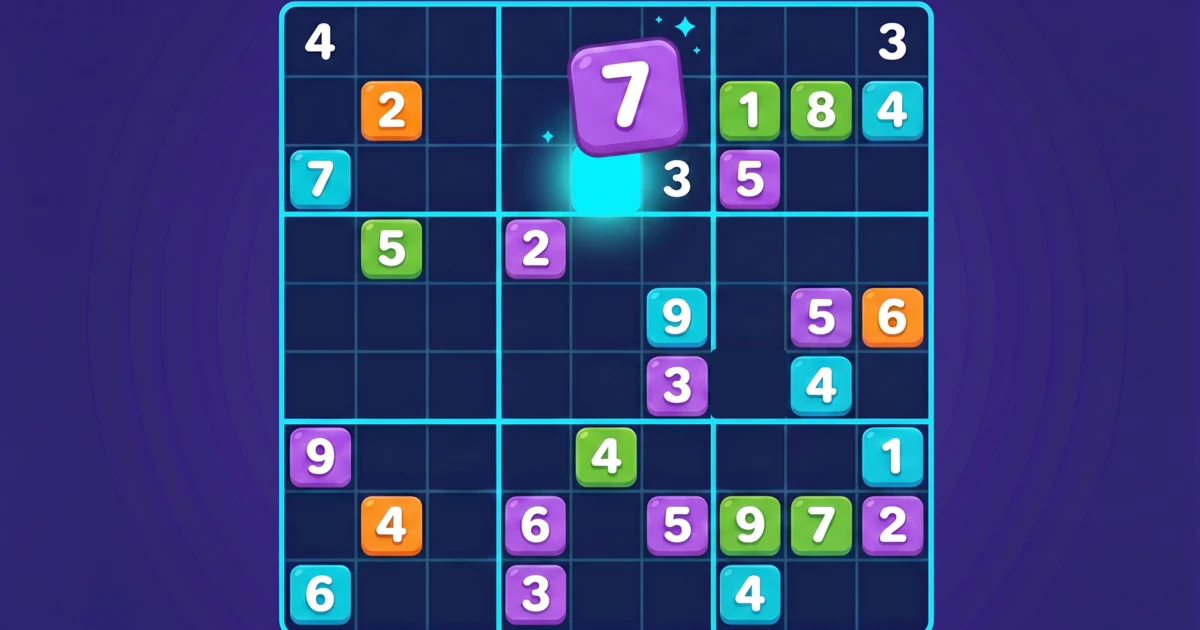
Killer Sudoku

Killer Sudoku

每日谜题

Killer Sudoku - Cage Sums Instead of Starting Numbers, Solo or With Friends

玩法变体:在线数独在线数独

3.0

评分

0

0

Killer Sudoku - Cage Sums Instead of Starting Numbers, Solo or With Friends

export function MiniCell({value, sum, sumTone}) { // Mirrors how the real board draws a cell: an opaque white square with a dark digit, and the // cage total tucked into the top-left corner just inside the dashed cage outline, in the same // three colors the board uses (see client/src/games/sudoku/SudokuGrid.tsx). const toneClass = sumTone === 'correct' ? 'text-green-600' : sumTone === 'over' ? 'text-red-600' : 'text-gray-500'; return (

{sum === undefined ? null : ( <span className={'absolute left-1 top-0.5 text-[11px] font-bold leading-none ' + toneClass}>{sum} )} {value ?? ''}
); }

export function combinationsOf(size, total) { // Every set of size different digits from 1-9 that adds up to total. const results = []; const walk = (start, left, remaining, picked) => { if (left === 0) { if (remaining === 0) { results.push(picked); } return; } for (let digit = start; digit <= 9; digit++) { walk(digit + 1, left - 1, remaining - digit, [...picked, digit]); } }; walk(1, size, total, []); return results; }

export function CageDemo() { const TARGETS = [ {total: 7, blurb: 'A low total leaves you almost no choice, so a cage like this is where you start solving.'}, {total: 15, blurb: 'The most flexible total there is. On its own it tells you almost nothing, so you need the row, column, and box to narrow it down.'}, {total: 24, blurb: 'Only one set again, at the top end. High and low totals are always the easiest cages to crack.'}, ]; const [target, setTarget] = useState(7); const [cells, setCells] = useState([null, null, null]); const filled = cells.filter(cell => cell !== null); const total = filled.reduce((sum, cell) => sum + cell, 0); const isFull = filled.length === 3; const tone = total > target || (isFull && total !== target) ? 'over' : isFull ? 'correct' : undefined; const combos = combinationsOf(3, target);

const place = digit => { if (cells.includes(digit)) { setCells(cells.map(cell => (cell === digit ? null : cell))); return; } const next = cells.indexOf(null); if (next >= 0) { setCells(cells.map((cell, i) => (i === next ? digit : cell))); } };

const pickTarget = nextTarget => { setTarget(nextTarget); setCells([null, null, null]); };

return (

Fill a Cage

This is one cage of three cells. Tap digits to drop them in, and tap a digit again to take it back out. The number in the corner is the total the three cells have to reach, and it turns green when you get there.

{TARGETS.map(option => ( <button key={option.total} type="button" onClick={() => pickTarget(option.total)} className={ 'rounded-lg px-3 py-1 text-sm font-bold text-white transition-none ' + (target === option.total ? 'bg-purple-500' : 'bg-white/10 hover:bg-white/20') } > Total {option.total} ))}
{cells.map((cell, i) => ( ))}
{[1, 2, 3, 4, 5, 6, 7, 8, 9].map(digit => ( <button key={digit} type="button" onClick={() => place(digit)} className={ 'h-9 w-9 rounded-lg text-lg font-bold active:scale-95 ' + (cells.includes(digit) ? 'bg-purple-500 text-white' : 'bg-white/10 text-white/80 hover:bg-white/20') } > {digit} ))}

{isFull && total === target ? 'That works. Every digit is different and they add up to the total.' : total > target ? 'Too high. Take a digit back out and try a smaller one.' : TARGETS.find(option => option.total === target).blurb}

{combos.length === 1 ? 'Only one set of three digits works: ' : ${combos.length} sets of three digits work: } {combos.map(combo => combo.join('+')).join(', ')}

); }

export function FortyFiveDemo() { // A single 3x3 box. Three cages sit entirely inside it and the ninth cell belongs to a cage // that carries on into the next box, which is the shape you look for when you use the 45 rule. const CELLS = [ {value: 1, cage: 'a', sum: 3}, {value: 2, cage: 'a'}, {value: 3, cage: 'b', sum: 14}, {value: 4, cage: 'c', sum: 19}, {value: 5, cage: 'b'}, {value: 6, cage: 'b'}, {value: 7, cage: 'c'}, {value: 8, cage: 'c'}, {value: 9, cage: 'outside'}, ]; const [isRevealed, setIsRevealed] = useState(false); const TONES = {a: 'bg-amber-400', b: 'bg-blue-400', c: 'bg-emerald-400', outside: 'bg-white/40'}; return (

{CELLS.map((cell, i) => (
<span className={'absolute bottom-1 left-1/2 h-1.5 w-7 -translate-x-1/2 rounded-full ' + TONES[cell.cage]} />
))}

The 45 rule

Three cages sit entirely inside this box, totalling 3, 14, and 19. That accounts for eight of the nine cells. The ninth belongs to a cage that carries on into the next box, so its total is no help here. The box has to hold 1 to 9 once each, so it adds up to 45, and the missing cell is whatever is left.

45 - 3 - 14 - 19 = {isRevealed ? '9' : '?'}

<button type="button" onClick={() => setIsRevealed(!isRevealed)} className="w-max rounded-lg bg-white/10 px-3 py-1 text-sm font-bold text-white hover:bg-white/20 active:scale-95" > {isRevealed ? 'Hide the answer' : 'Show the answer'}
); }

Killer Sudoku

Killer sudoku is a free online sudoku variant where the grid gives you sums instead of starting numbers. The board is carved into cages, small groups of neighbouring cells drawn with a dotted outline, and each cage prints the total its digits must reach. No digit repeats inside a cage, and the rest is normal sudoku: every row, every column, and every 3x3 box holds 1 to 9 once each. You can play it on this page right now in your browser, alone or with friends on a shared board, at four difficulty levels, with no download and no signup.

Because the cages carry the information, killer grids start almost bare. An Easy puzzle here opens with four given digits and Expert usually opens with none at all, so your first move comes from arithmetic rather than from scanning for a number that is already on the board.

Killer Sudoku Rules

There are two rules on top of ordinary sudoku, and they are both about cages. A cage's digits have to add up to the small number in its top-left corner, and a digit can only appear once inside a cage. The second rule matters more than it looks, because it is what makes a total useful. A three-cell cage adding to 7 could be 1+2+4 or 1+3+3 if repeats were allowed, but they are not, so 1+2+4 is the only option and all three cells are settled before you have placed anything else.

Extreme totals are the way in. Low totals have to use the small digits and high totals have to use the large ones, so a two-cell cage adding to 3 is 1 and 2, a two-cell cage adding to 17 is 8 and 9, and a three-cell cage adding to 24 is 7, 8, and 9. Middling totals like 15 are the vaguest and are usually the last cages you fill.

The other technique worth learning early is the 45 rule. Every row, column, and 3x3 box contains each digit once, so each one adds up to 45. Find a row, column, or box where every cage sits fully inside it except for a cell or two, add up the cage totals, and the difference from 45 is what is left over.

One last detail: a cage can be a single cell. When it is, its total is simply the digit that goes there, which is the same thing as a given number in classic sudoku. Easy puzzles here include eight of those and Expert includes three, and that gap is a large part of why the difficulties feel so different.

Play Killer Sudoku Online Free

The board at the top of this page is already set to killer, so pressing play is the fastest way in. From anywhere else on Foony, open Sudoku, choose Create Room, and pick the Killer Sudoku card from the presets, or flip the Variant setting from Classic to Killer on any room you are setting up.

Four difficulty levels change both the cage shapes and how much of the grid you get for free:

Easy and Medium

Cages hold up to four cells, and plenty of them hold just one. Easy starts with four given digits and Medium with one, on top of the single-cell cages.

Hard and Expert

Cages stretch to five cells and single-cell cages get rare. Both normally open with no given digits at all, so the sums are all you have.

Every puzzle has exactly one solution, and it is checked before you ever see it. The generator builds cages from a finished grid and then solves the result under killer rules to confirm the answer is forced, so you never have to guess.

The rest of the room settings work the same as classic sudoku. Mistake tolerance is Casual (unlimited), Normal (three mistakes), or Perfectionist (one mistake and the puzzle ends). The host can put a clock on it, anywhere from 5 to 60 minutes, or leave it off. Killer solves are given more time for the same reward than classic ones, because they take longer, and they are scored on their own scale so a long solve is not penalised.

While you play, the board does the arithmetic with you. Each cage total sits in the corner of its first cell, turns green once the cage is full and correct, and turns red the moment your digits pass the total, so a slip shows up on the spot instead of forty cells later. Selecting a cell tints the rest of its cage, which is the fastest way to see the shape of a cage that wraps around a corner. Pencil marks work exactly as they do in classic sudoku.

Multiplayer Killer Sudoku

Killer is the sudoku variant that benefits most from a second pair of eyes, and every Foony room supports one. Turn Co-op on when you create the room and everyone joins a single team sharing one grid, with live cursors, so you can split the board by region, have someone work the cage arithmetic while another person scans rows, or just talk through a corner that will not open. It is also the easiest way to teach the variant to someone, since they can watch a cage get cracked instead of reading about it.

Leave Co-op off and everyone gets the same puzzle on their own grid, with first to finish legally taking the win. That covers a 1v1 race, a friends-only match, and a tournament room, which holds up to 1,000 players on one seed. Share the room link and people join from any modern browser on desktop, tablet, or phone. No account is needed to play, only to keep levels, ranks, and unlocks across devices.

Killer Sudoku Tips and Cage Combinations

Sweep for extreme cages first. Before you place anything, look for two-cell cages totalling 3, 4, 16, or 17, and three-cell cages totalling 6, 7, 23, or 24. Each of those has exactly one possible set of digits, and one settled cage usually gives you a second through the ordinary row and column rules.

Use the 45 rule on the edges of the grid, where boxes are most likely to have a single cell poking out of a cage. It also works across several rows or columns at once. Two full rows add up to 90, three add up to 135, so a cage that spills a single cell out of a three-row band gives that cell away.

Watch for cages inside one row, column, or box. Their digits cannot repeat anywhere in that unit either, so a two-cell cage totalling 16 inside a single box removes 7 and 9 from every other cell in that box, which is often more useful than knowing where they go.

Play Hard and Expert in Casual mode until the arithmetic is second nature. A wrong digit in killer usually comes from a miscount rather than a broken deduction, and there is little to learn from a puzzle that ends on one. Switch to Perfectionist once you stop miscounting, and chase Flawless Victory then.

Sudoku Leaderboards, Achievements, and Boards

Killer solves count towards everything classic solves do. Wins feed the sudoku leaderboards, which filter by day, week, month, year, or all-time.

There are eight sudoku achievements and killer is a fair route to most of them. Flawless Victory asks for zero mistakes on any puzzle, Zen Master for a solve with no hints, and Hard as Nails and Puzzle Master for Hard and Expert solves with three mistakes or fewer, all of which count on a killer board. Quick Solve is the one to leave for classic, since it wants an Easy puzzle finished inside five minutes.

Playing also drops sudoku boards and number styles. There are 12 boards, including Wooden, Zen Garden, Blueprint, and Neon, and 12 number styles such as Ink Brush, Fountain Pen, and Gilded, with the Calligraphy style handed out at level 50. They change how the grid looks and nothing else. The dotted cage outlines and their totals draw over whichever board you have equipped.

Classic Sudoku and Other Puzzles

If the cage arithmetic is new to you, the sudoku page covers the base rules the variant is built on, along with the same co-op rooms, races, and difficulty levels. Working through a Hard classic puzzle first makes killer much easier to pick up, because once the cages have given you a dozen digits the rest of the solve is ordinary sudoku.

在线数独:常见问题

我能和朋友在同一个棋盘上合作玩数独吗?
可以。在 Foony 数独 创建房间时启用合作模式(或写作"coop",是一回事),大厅里的所有人会组成一队,共享一个 9x9 棋盘,并能实时看到彼此的光标位置。你可以把不同区块分给队友,互相在落子前帮忙复核,也可以在困难和专家级谜题上一起讨论那些更棘手的推理。这是教新手玩数独最轻松的方式,根本不用凑过去看别人的屏幕。
Foony 提供哪些数独难度?
Foony 数独 有四个难度,每个房间选定一次。简单只需要用到大家一开始都会的两招:某个格子只剩一个数字能填,或者某个数字只剩一个格子能放。普通会加入数对,也就是两个格子共享同样的两个候选数,把其他数字都挡在外面;还有 X 翼,也就是某个数字在两行中都被锁定在相同的两列。困难会加入三数组和这类结构的更大版本,从这里开始,写候选数就很有用了。专家会加入链式推理,你要顺着一个数字追过好几个格子,排除远处某个格子的候选数。难度越高,开局给出的数字越少,完成后获得的 XP 和道具掉落也越多。
Foony 数独是免费的吗?
是的。Foony 数独 在浏览器里完全免费。谜题、多人房间、锦标赛和成就都没有任何付费墙。商店里只卖可选的外观棋盘和数字样式;那里的任何东西都不会改变谜题生成器或规则。
休闲、普通和完美主义模式有什么区别?
Foony 数独 上的三种模式改变的是错误容忍度的严格程度。休闲模式允许无限次错误,谜题永远不会以失败告终,非常适合新手学习。普通模式最多允许三次错误,之后游戏结束。完美主义模式只要错一步游戏就结束,如果你想冲击"完美胜利"成就或者突破自己的能力上限,这就是合适的设置。高风险的模式会给出更多 XP 和更多道具掉落。
数独怎么玩?
数独是一种逻辑谜题,棋盘是一个 9x9 的网格,被划分成九个 3x3 的方框。开始时网格里会预填一些 1 到 9 的数字。你的目标是把所有空格填满,使得每一行、每一列以及每个 3x3 方框都恰好包含 1 到 9 的每个数字一次。整个过程不涉及任何算术,只需要逻辑推理。Foony 数独 会高亮合法的落子位置,用红色显示冲突,并提供铅笔标记功能,方便你在还没确定的格子里记录候选数字。
我可以不注册就玩数独吗?
可以。打开 Foony 数独 就能直接开始解题,不需要账号。只有当你想要跨设备等级同步、持久化的排行榜排名以及商店解锁时,才需要注册。完整的规则、所有四个难度等级、所有三种游戏模式以及多人房间,都不需要账号就能使用。
怎么和朋友在线玩数独?
打开 Foony 数独,点击"和朋友一起玩"创建一个私人房间,然后把邀请链接分享出去。朋友们可以在电脑、平板或手机的任何现代浏览器上加入,不用注册账号,也不用下载安装。选好难度、选好模式(休闲 / 普通 / 完美主义)、决定房间是合作还是竞速,你就可以开始解题了。
Foony 数独有排行榜、成就和外观道具吗?
有,三样都有。在 Foony 数独 获胜会计入公开排行榜,还能按日、周、月、年或历史总榜筛选。游戏里有 12 个成就,包括“完美胜利”(任意谜题零失误)、“极速解题”(5 分钟内完成一道简单谜题)、“坚如磐石”和“谜题大师”(以不超过三次失误完成困难/专家谜题)、“禅意大师”(不用提示解开一道谜题),以及四个每日谜题成就,最高是完成 100 道每日专家题的“今日最难”。还有 13 种装饰盘面(木质、禅意花园、蓝图、彩绘玻璃、锦鲤池、古老卷轴等)和 13 种数字样式(墨水笔、钢笔、毛笔、鎏金、书法、宝石等),可以从商店、掉落奖励或每日谜题中获得。皮肤只会改变外观,绝不会影响谜题生成。
我能和朋友竞速、玩双人数独,或者举办数独锦标赛吗?
可以,三种玩法都在同一个模式里。在 Foony 数独 创建房间时关闭合作模式,大厅里的每个玩家都会在自己的棋盘上拿到同一个起始谜题;第一个合法填满棋盘的人获胜。这就同时涵盖了 1v1 / 双人数独、好友间的竞速,以及单一题目最多 1000 人参赛的竞技数独锦标赛。搭配完美主义的零容错设置,就能打一场惨烈的冲刺——一步错就出局;或者搭配休闲模式,来一轮轻松的"看谁先做完"。
我可以给数独设定时间限制吗?
可以。Foony 数独 的房主可以把每道谜题的时间限制设在紧凑的 5 分钟到 60 分钟之间,或者完全关掉计时,享受轻松的不限时对局。时间限制和难度、错误容忍度设置是独立的,所以你既可以在休闲容错下用 60 分钟的钟挑战专家级谜题,也可以在完美主义模式下用 10 分钟冲刺一道简单题。
我能在学校或公司不受限制地玩 Foony 数独吗?
Foony 数独 完全在浏览器里运行,所以在大多数封锁独立游戏安装的学校和公司网络上都能用。没有可执行文件需要运行,也不需要应用商店账号,页面本身通过 HTTPS 从 foony.com 加载。如果你的网络直接封锁了 foony.com,可以请 IT 管理员把它加入白名单;我们并不在常见的"被封游戏"名单上。
Foony 的数独谜题保证有唯一解吗?
是的。Foony 数独 生成的每道谜题都只有一个解,而且完全可以靠逻辑推出来,不需要猜。如果你发现自己在碰运气,那可能是漏掉了某个限制条件,或者需要更高级的技巧(困难难度常用横跨两三行的结构,专家难度则要用从一个格子追到另一个格子的链式推理)。按定义来说,有多个解的数独就是无效谜题,我们的生成器绝不会产出这种题。每道上线的谜题还会交给标准评级工具 Sudoku Explainer 重新检查;只要它给出的难度和我们的评级不一致,这道题就会被丢弃。
8 Ball Pool online multiplayer billiards icon