



Turtle Mahjong - Free Turtle Mahjong: The Classic 144-Tile Five-Layer Board
 Mahjong Connect
5.0
Rating
22
0
Turtle Mahjong Online
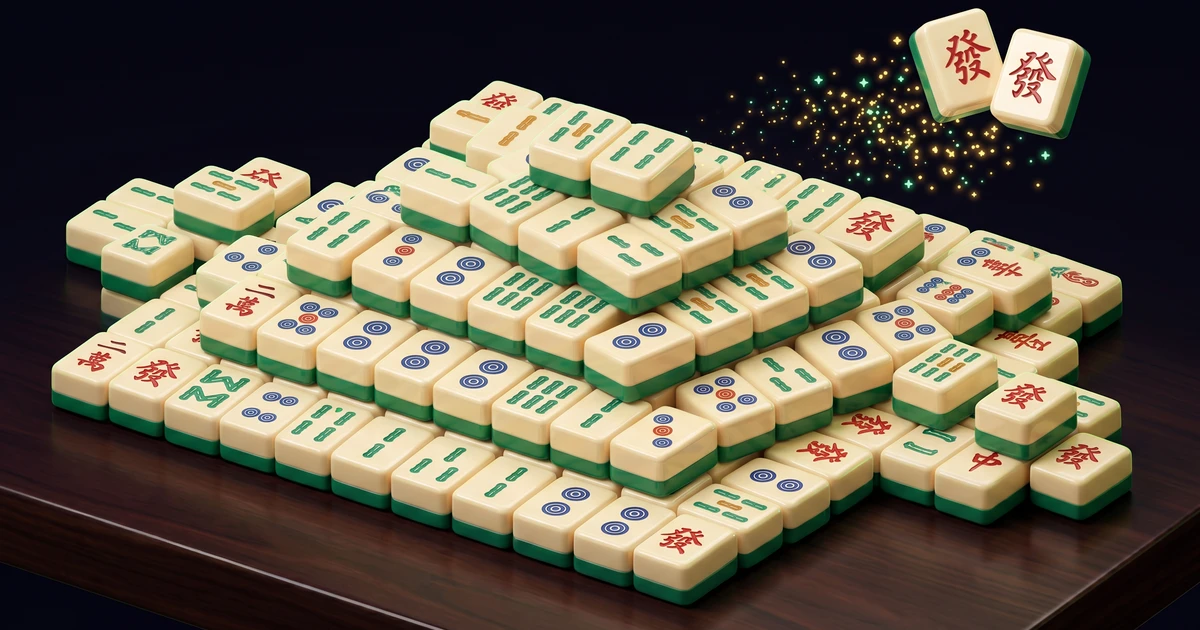
Turtle mahjong is the original mahjong solitaire board, 144 tiles stacked five layers high in the outline of a turtle, and this page deals exactly that board every game. The regular mahjong solitaire page on Foony rotates through 25 different boards when you leave the board setting on Random, while the Classic Turtle preset locks in the original one. Every deal here can be fully cleared, friends can join your board through an invite link, and it all runs free in the browser with nothing to install.
If you remember playing a tile matching game on an old Windows machine, on a plane, or on a library computer, it was almost certainly this board.
The Mahjong Turtle Layout
Seen from above, the board really does look like a turtle. A wide body of tiles forms the shell, one tile pokes out on the left for the head, two trail off on the right for the tail, and a hill of smaller and smaller squares rises in the middle of the back, five tiles tall at the peak.
When the game starts, most of the board is locked. Only the tiles around the edges and on top of the hill can be picked up at first, and your job is to open up the rest in a sensible order.
Free Tiles on a Stacked Board
A match means clicking two tiles that show the same face, which removes both from the board. The rule that makes turtle mahjong a real puzzle is which tiles you are allowed to click. Players call a clickable tile a free tile, and a tile is free when no tile lies anywhere on top of it and at least one of its two sides, left or right, has no neighbor touching it. Foony dims every blocked tile, so the playable ones are always obvious.
Most tiles only match an exact copy of themselves. The four flower tiles all match each other, and the four season tiles do too. A real mahjong set draws each flower as a different plant, but Foony gives all four the same blossom face and all four seasons the same leaf, so those pairs look like exact copies anyway and you never have to think about the exception.
How to Play Turtle Mahjong on Foony
Pressing play on this page already selects the Classic Turtle preset, so you can just start. From anywhere else on the site, create a mahjong room and pick the Classic Turtle card on the Presets tab of the room settings. The Advanced tab keeps the turtle board while letting you change everything around it. You can add a clock of 3, 5, 10, 15, or 30 minutes, switch the room to co-op, and set the player count anywhere from solo up to 1,000 people on one shared board.
A room with more than one player is a race by default. Each pair is worth 10 points to whoever clicks it first, and matching again within 4 seconds adds a 5 point streak bonus. Ticking the Co-op box removes the competition entirely, and everyone works together on the same board. Friends can also hop into a board that is already half cleared.
Two buttons help when you are stuck. The Hint button can be used once every 10 seconds to highlight a legal pair. And if no legal moves remain at all, a banner offers a shuffle that rearranges the leftover tiles into a position that can still be finished. In rare games no arrangement of the tiles left can be cleared (for example, two matching tiles stacked on each other), and then the game ends on the scores so far. You will never need a shuffle on a fresh board, because every deal is generated backwards from a completed game, so at least one full clear always exists from the start.
Turtle Mahjong Strategy
- Clear the hill early. The top tile caps a 4 tile platform, which caps a 16 tile square, which caps 36 more. Every match you make on the hill uncovers tiles below it, while matches on the flat rim uncover almost nothing.
- Take the head and tail when they show a match. The three tiles poking out at the far left and far right press against the ends of the longest rows. Until they go, the tiles they touch can never open on that side.
- Work long rows from the ends. A tile in the middle of a 12 tile row only becomes free after every tile between it and one end is gone. Starting both ends early gives you two fronts instead of one.
- Prefer the match that frees two tiles over the match that frees none. When the same face shows in three places, the pair you pick decides what opens next. Choosing the two copies that each sit on top of something is nearly always right.
The Original Mahjong Solitaire Layout
The turtle is the oldest computer mahjong solitaire board. The first computer version of the game was built in 1981, and when Activision published Shanghai in 1986, it marketed the game around this tile arrangement, calling it the Turtle. Nearly every mahjong solitaire release since has shipped some version of it, including Mahjong Titans on Windows Vista and Windows 7, which is where a lot of people first played it. Whatever program you learned on, the board here will look familiar.
More Mahjong Solitaire Boards
When the turtle starts to feel too familiar, the main mahjong solitaire page rotates through 25 boards, from a six layer tower to dragons, pagodas, and Mount Fuji, with the same guaranteed clearable deals on all of them. And if you want a different matching rule, Mahjong Connect lays every tile out flat on one layer and has you link pairs with a clear path instead.