
















Checkers Online
Checkers Online
Checkers Online - Free Multiplayer Checkers and Draughts: Play Friends or 7 AI Bots
 International Draughts
 Russian Draughts
 Brazilian Draughts
 Canadian Draughts
4.4
Rating
162
26

Free Online Checkers: Multiplayer with Friends or Seven AI Bot Tiers
Foony Checkers is a free online checkers game in your browser. Match a friend through a private room URL or take on seven AI bot tiers from Trivial to Grandmaster, with one-click presets for International, Russian, Brazilian, and Canadian Draughts layered on top of the classic American ruleset. Pick a piece color and make your first diagonal move.
The renderer is mobile-first WebGL, so the board reads cleanly on desktop, tablet, or phone, and the controls are tap-to-aim friendly on touch screens. Forced jumps are highlighted automatically, the optional 25-second turn clock keeps games moving, and a faint move-suggestion tooltip is one click away when you want a hint without the bot playing for you.
A Free Browser-Based Checkers Game with Four Draughts Variants
Most free checkers sites only ship American Checkers (8×8 board, no flying kings, no backward takes). Foony does that as the default, then layers four named international presets on top with one click each, plus a custom rules panel that exposes every underlying setting as a toggle. That is the same depth a desktop Draughts client would offer, served free in a browser tab.
The custom rules panel covers board size (8×8, 10×10, or 12×12), forced takes, can take backwards, can chain takes, flying kings, immediate king promotion, must take the longest chain, threefold-repetition draws, who plays first, and the winning condition (capture all pieces or block all moves). Mix and match for a house ruleset, share the room link, and your opponent joins on the rules you set without an account or install.
Multiplayer Checkers with Friends, or Sparring vs Seven AI Bot Tiers
Checkers rooms scale from a quick solo game against a single bot up to friends-only 2-player lobbies built from a single shared invite link. The default room is a head-to-head match where one player controls the dark pieces and the other controls the light pieces. Guests can join and play without an account.
Playing solo? Spin up bots at seven difficulty tiers (Trivial, Easy, Novice, Skilled, Expert, Master, Grandmaster) to drill openings, study the king-row endgame, or warm up before a real match. Trivial and Easy play loose enough to forgive while you learn the patterns. The middle tiers punish hanging pieces and over-extended kings the way an experienced human would. Master and Grandmaster simulate hundreds of candidate lines per turn and find tactical motifs that a strong club player would spot, with no countdown pressure if you take longer between moves.
International, Russian, Brazilian, and Canadian Draughts: Four Built-In Rule Variants
Checkers is the American name for the family of games called Draughts in most of the rest of the world. Foony's preset menu jumps you straight into the four most-played international variants without forcing you to memorize a rules toggle list:
- International Draughts is the World Draughts Federation tournament standard. Played on a 10×10 board with four rows of pieces per side (20 each), regular pieces capture forward and backward, kings are "flying kings" that move and capture across multiple empty diagonal squares, and you must always take the longest available capture chain when more than one is legal.
- Russian Draughts uses the 8×8 American board but adds flying kings, backward captures, and immediate king promotion on the back row even when the king is mid-jump. Combos through the king row are part of the standard repertoire.
- Brazilian Draughts is essentially International rules on the smaller 8×8 board: flying kings, backward captures, must-take-longest-chain, but kings only promote at the end of a chain (not mid-jump). The smaller board makes calculation tighter.
- Canadian Draughts is the largest variant Foony supports, a 12×12 board with five rows of pieces (30 per side) and the same flying-kings + longest-chain rules as International. Games run longer and the tactical surface is enormous.
Each preset is one click in the room settings; you can also open the custom rules panel and dial individual settings for a house ruleset.
Leaderboards, Achievements, and Cosmetic Pieces
Every Checkers match counts toward Foony's public Checkers leaderboards, filtered by day, week, month, year, or all-time. If you want a single number that tracks whether your game is actually improving, that is the place to watch.
Checkers is a newer addition to Foony, so the Checkers achievements list currently has one starter milestone (Checkers Newbie for your first game) plus level-rewarded piece drops: hitting checkers account level 15 unlocks the Tomato Piece, level 30 unlocks the Onion Piece, and rare level-30+ drops include the Fox and Pearl pieces alongside chess board cosmetics that carry across to our Chess game.
The Checkers pieces and boards catalog stocks 28+ piece skins paid in coins from regular play: everyday Red and Blue through Fox, Pearl, Penguin, Cookie, Mars, Moon, Sheriff's Badge, Tomato, Onion, Roulette, and Caramel, with chess boards shared between the two games. Skins are decoration only — equipping the flashiest piece never changes move legality, and the wood grain of a board is just a backdrop for your leaderboard run.
How to Play Checkers
Checkers is a two-player strategy board game believed to have descended from Alquerque in ancient Egypt and now played in dozens of regional variants worldwide. The standard American game is played on the same 64-square 8×8 board you would use for chess, with each player controlling 12 round pieces placed on the dark squares of the three rows closest to them. The objective is to capture all of your opponent's pieces or block them so they cannot make a legal move.
The Setup
<img alt="Checkers Setup" src="https://foony.com/img/posts/checkers/image1.webp" style={{margin: 8}} />
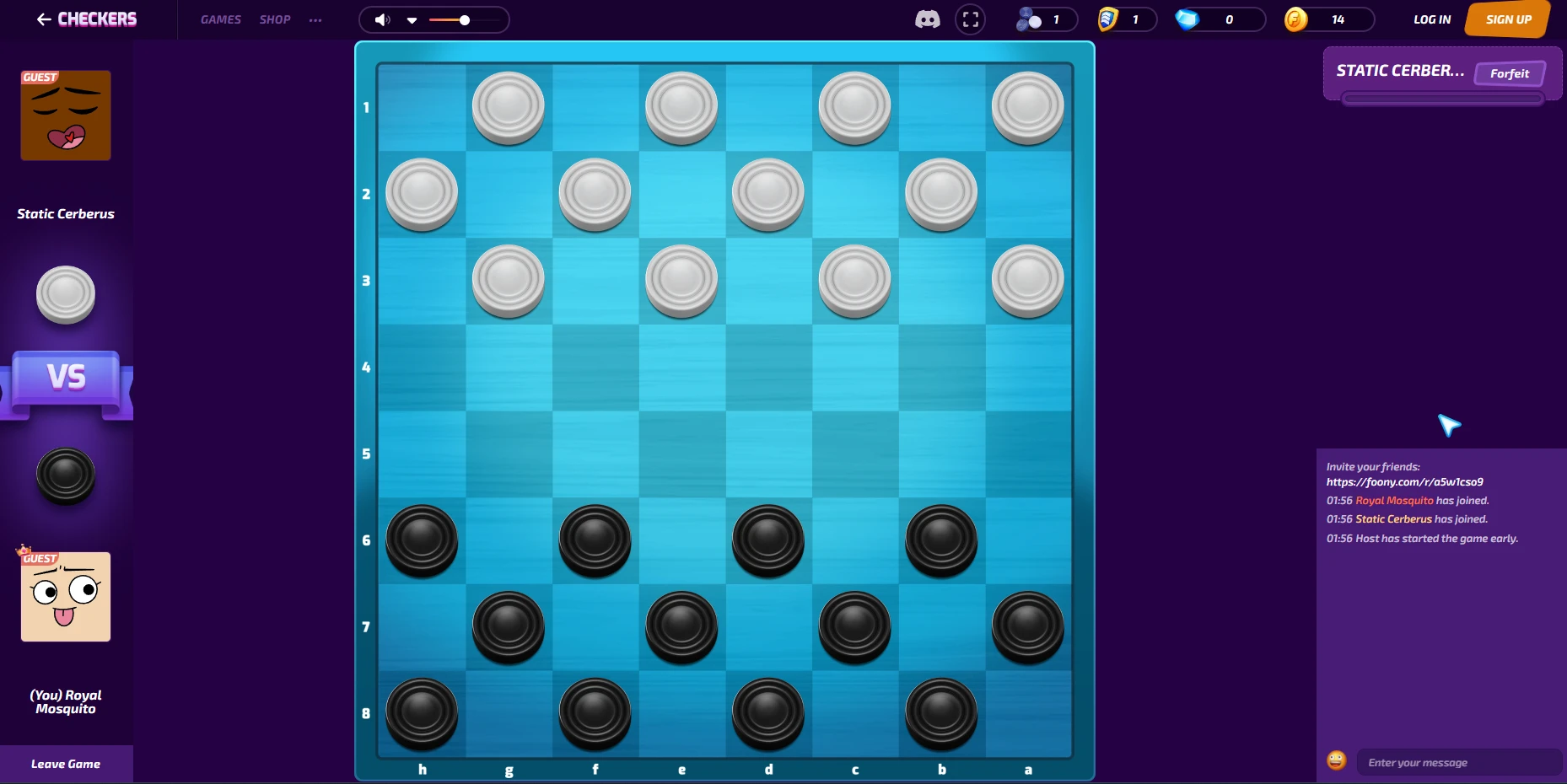
Each player places their 12 pieces on the dark squares of the three rows closest to them. Pieces always sit on the dark squares; the light squares stay empty for the entire game. By tournament convention the player with the darker pieces moves first; on Foony you can flip a coin in the room settings or just pick a side and start.
Movement and Captures
Regular pieces move one square diagonally forward onto an empty dark square. They cannot move backward, sideways, or onto a light square. To capture an opponent's piece, you jump over it diagonally into an empty square on the other side. The captured piece is removed from the board.
If after landing you have another legal jump from the same piece, you must keep jumping in the same turn — captures are mandatory and chain captures are mandatory once a chain has started. This is how most non-trivial games are won: setting up a position where your opponent is forced into a chain that hands you two or three pieces in a single turn.
Kings
When one of your pieces reaches the opposite back row (your opponent's "king row"), it is promoted to a king. Kings move and capture diagonally in any direction — forward and backward — making them roughly twice as flexible as regular pieces. In flying-king variants like International, Russian, Brazilian, or Canadian Draughts, kings additionally slide multiple empty squares along a diagonal in a single move, so a king can reach across the board to deliver a long-range capture. In the default American Checkers ruleset on Foony, kings move one square at a time like regular pieces but in any direction.
Winning the Game
You win when your opponent has no legal moves. That happens either because you have captured all of their pieces, or because every remaining piece they have is blocked from making any legal diagonal move. There is no "checkmate"-style instant-win square; the game ends when the move generator runs dry.
Draws and the 40-Move Rule
A position can also end in a draw. The two common cases are threefold repetition (the same board position appears three times with the same player to move) and tournament Checkers' 40-move rule (40 consecutive moves without a capture or a king promotion). Foony enforces threefold repetition by default; you can also disable it in the custom rules panel for casual games.
Checkers Strategy: Center Control, King Rows, and the Safety Game
The fastest path to better Checkers is usually not a tactic; it is positional. Three positional patterns separate strong from average players.
Control the center. The four center squares give the most diagonal mobility, and a piece parked there influences both wings of the board. Push toward the center early and avoid wandering pieces to the edges where they have only two diagonals to use.
Hold the king row. Pieces on your own back row block the opponent from promoting. New players tend to advance the entire army uniformly, opening a clean path for the opponent's first king. Keeping at least one or two pieces anchored on your back row in the early-middle game is one of the cheapest defensive habits to acquire.
Use the safety move. When the position is balanced and there is no clean capture available, the right play is often to refuse the bait: move a piece that creates no jump for either side, force the opponent to commit first, and respond to whatever they offer. Trades where you take two and they take one are how most well-played Checkers games are decided.
The seven bot tiers on Foony are calibrated for exactly this kind of practice. Trivial and Easy give you space to drill openings; Skilled and Expert force you to value your back-row defense; Master and Grandmaster will punish a single wandering piece with a multi-jump combination, which is the cleanest feedback you can get on whether your position is actually safe.
Prefer Pure Strategy Without Forced Jumps? Try Chess
If the forced-jump and diagonal-only constraints of Checkers feel too narrow, the same friend-link multiplayer flow runs our Chess game. Chess swaps Checkers' 24 identical pieces for 32 pieces of six different types, drops the forced-capture rule, and adds the deeper opening + endgame theory that Checkers' simpler movement intentionally avoids. The chess board cosmetics you unlock on Foony are shared between the two games, so anything you earn here is equippable in chess and vice versa.