


4/1/2025
How to Play Checkers: A Beginner's Guide to Mastering Strategy and Fun
Checkers is a two-player strategy board game with simple rules and surprisingly deep tactics. This guide walks beginners through how to set up the checkers board, the rules for moving and capturing pieces, how kings work, the penalty for skipping a forced jump, and the basic strategy you need to start winning games.
Quick Summary of Checkers Rules
The shortest possible version, in case you only have a minute:
- 1. Each player gets 12 pieces on the dark squares of the three rows nearest them.
- 2. Players sit on opposite sides of the board, take turns, and only ever move their own pieces.
- 3. Pieces slide one square diagonally forward onto an empty dark square.
- 4. You capture by jumping over a neighbouring opponent piece into the empty square beyond it.
- 5. Capturing is mandatory in most rule sets. If a jump is on the table, you have to take it.
- 6. Reach the far row and your piece is "crowned" a king, free to move backward as well as forward.
- 7. You win when your opponent has no legal move left.
The rest of this page expands every line above.
How to Set Up the Checkers Board
Standard American checkers is played on the same 64-square 8×8 board you would use for chess, with light and dark squares alternating in a checkerboard pattern. Only the dark squares ever come into play. Light squares stay empty for the whole game.
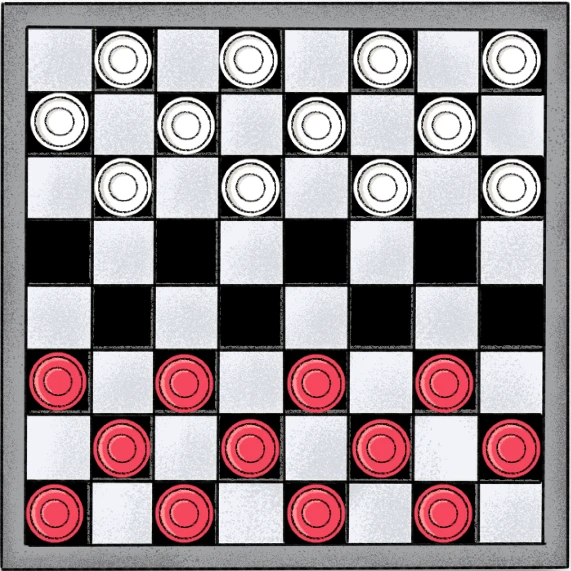
To set up:
- Orient the board so each player has a dark square in their bottom-left corner.
- Each player takes 12 pieces of one colour. One side gets dark pieces (usually black). The other gets light pieces (usually white or red).
- Place each piece on a dark square in the three rows nearest you. Every dark square in those three rows holds a piece. Every light square stays empty.
By traditional rule, the player with the darker pieces moves first, and turns then alternate. You only ever move your own pieces. A player cannot move the opponent's pieces under any rule variant.
The Rules: Moving Pieces Diagonally
A regular piece moves one square diagonally forward onto an adjacent empty dark square. That is the entire move. No straight-line moves, no two-square slides, no jumping over your own piece. At the start of the game, every piece moves forward only.
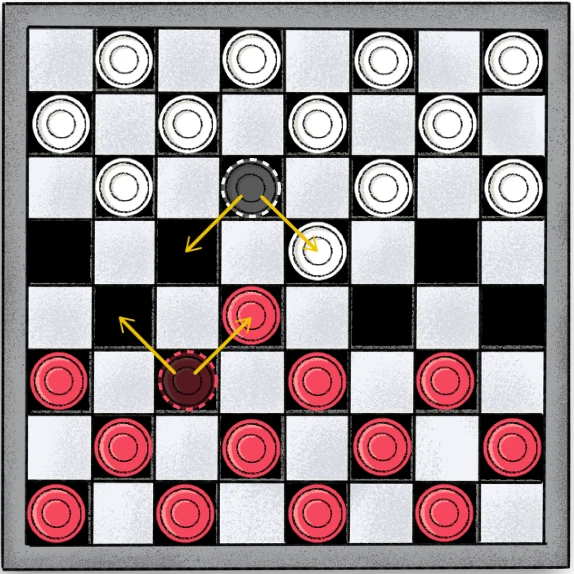
If you can move, you have to. There is no "pass" turn. The only time you cannot move is when every piece you own is blocked, and that means you have lost (more on that below).
How to Capture (Jumping in Checkers)
If the square diagonally next to one of your pieces holds an opponent's piece, and the square immediately beyond it (still diagonal, still a dark square) is empty, you capture by jumping. Hop your piece over the opponent's piece and land in the empty square. The piece you jumped is removed from the board.
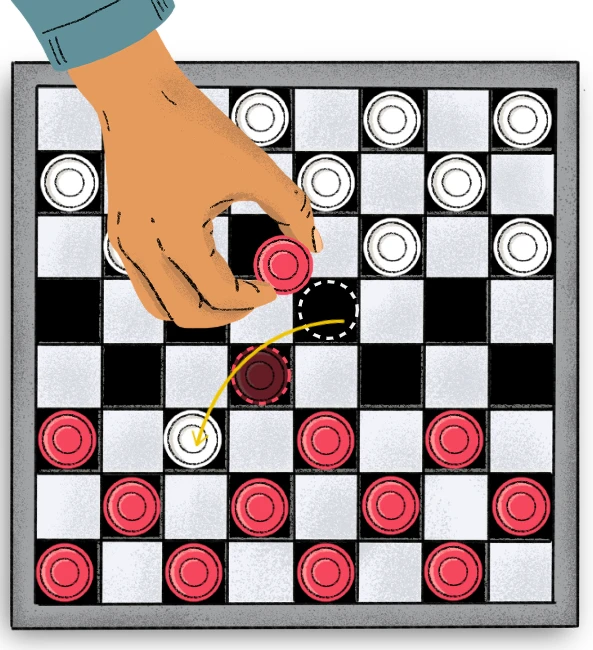
Two rules make jumping the most important move in checkers:
- Captures are mandatory. In most official rule sets (American, English, International, Russian, Brazilian, Canadian), if a jump is available, you must take it. You cannot ignore a jump and play a quiet move instead.
- Multi-jumps are mandatory too. If your piece lands and another jump is available from that new square, you keep going. A single turn can take two, three, or even four opponent pieces in one chain.
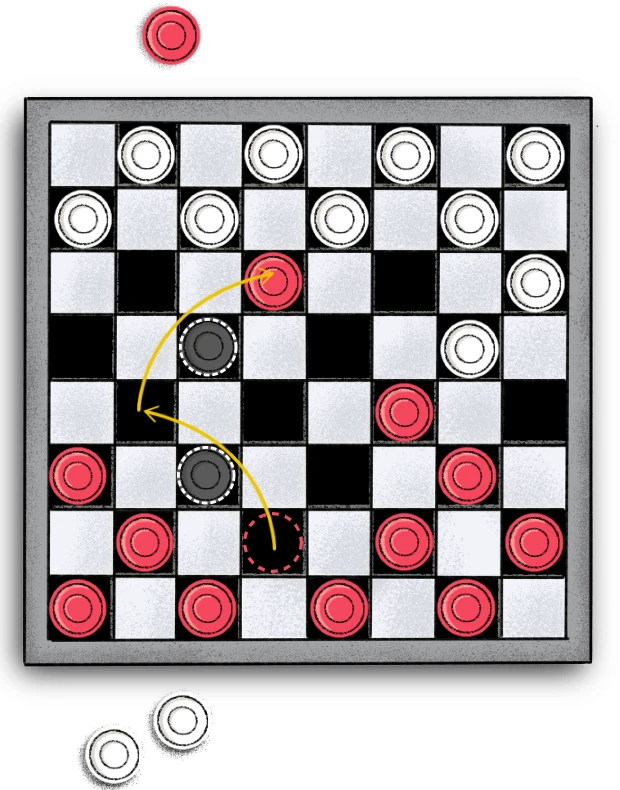
The whole shape of the game flows from this. Most decisive games are won by setting up a position where the opponent is forced into a chain that hands you two or three pieces at once.
Checkers King Rules
When one of your pieces reaches the far row of the board (your opponent's back rank, also called the king row), it is "crowned" a king. Stack a captured piece on top of it as a marker, or if you are playing online your client flips the design.
A king moves and captures diagonally in any direction: forward and backward. That makes it roughly twice as flexible as a regular piece and is usually enough to swing an even endgame. Crowning the first king is one of the biggest momentum shifts in any checkers game.
A few notes on king rules that often surprise new players:
- In American checkers, kings move one square at a time, like regular pieces, but in any of the four diagonal directions.
- In International, Russian, Brazilian, and Canadian Draughts, kings are "flying kings" that slide any number of empty squares along a diagonal in a single move and can capture from a distance.
- If a regular piece reaches the king row mid-jump in American checkers, the turn ends there. It is not allowed to keep jumping as a king on the same turn. Russian Draughts is the exception that lets you continue.
The Huff: Penalty for Refusing a Capture
In old-school casual play, if a player failed to take a forced jump, the opponent could remove (or "huff") the piece that should have captured. This was sometimes called the muffin rule. Where two or more such positions existed, the offending player would forfeit every piece that should have moved.
The huff is no longer used in tournament play. The modern World Checkers Draughts Federation rules simply require that the player retract the illegal move and play the correct jump. Some house rule sets still keep the huff for fun, and a handful of variants make capturing optional altogether. If you are playing in person, agree on which version you are using before you start.
How You Win at Checkers
A player loses when they have no legal move at the start of their turn. That happens in one of two ways:
- No pieces left. Your opponent has captured every piece you had on the board.
- All pieces blocked. You still have pieces, but every single one is wedged against an opponent piece, the edge of the board, or both, with no diagonal square open.
Either case is enough. Trapping the last two pieces in a corner is just as much a win as capturing all 12.
A position can also end in a draw. The two common draw conditions are threefold repetition (the same board position repeats three times with the same player to move) and the 40-move rule (40 consecutive moves with no capture and no king promotion). Most online clients enforce both automatically.
Beginner Checkers Strategy Tips
A few habits separate someone who knows the rules from someone who actually wins. None of this is exotic. It just compounds over a game.
- Hold your back row. Keeping pieces on your own king row prevents your opponent from promoting. Beginners march everyone forward and hand the opponent a free king.
- Push toward the centre. A piece in the four central squares has access to four diagonals and influences both wings. A piece on the edge has only two.
- Move in pairs. A lone piece is an easy target. Two pieces side by side support each other and are much harder to capture cleanly.
- Use the safety move. When the position is balanced and there is no clean capture, play a quiet move that creates no jump for either side and force your opponent to commit first.
- Set up forced chains. Because captures are mandatory, you can turn the rule against your opponent. Sacrifice one piece to force a jump that lands them in a position where you take two back.
- Open with a classic. "Old Faithful" (11-15 in standard checkers notation) is one of the most studied and reliable opening moves for the dark side. The most common reply for the light side is 22-17 or 23-18. You do not need to memorise opening theory, but knowing the first move helps you plan the next two.
The fastest way to internalise all of this is to play a few hundred games against a bot that never blunders. Lose, see why, and try the line again.
American Checkers vs International Draughts
What Americans call "checkers" is one regional variant of the global family known as draughts. The biggest differences:
- Board size. American checkers and English draughts use an 8×8 board. International Draughts uses 10×10. Canadian Draughts uses 12×12.
- Piece count. 12 per player on 8×8, 20 on 10×10, 30 on 12×12.
- Backward captures. In American checkers, regular pieces never capture backward. In International, Russian, Brazilian, and Canadian Draughts, regular pieces capture backward as well as forward.
- Flying kings. International, Russian, Brazilian, and Canadian kings slide multiple squares along a diagonal and can capture from afar. American kings move one square at a time.
- Longest-chain rule. International, Brazilian, and Canadian rules require you to take the longest available capture chain when more than one is legal. American rules let you choose any legal jump.
If you have only ever played American checkers, International Draughts feels like a different game on first contact. Same diagonal-only movement, same dark-squares-only board, completely different tactical pace.
Where to Play Checkers Online
The fastest way to actually learn the patterns is to play. You can play checkers online for free on Foony in your browser, with friends through a private room link or against seven AI tiers from Trivial up to Grandmaster. American checkers is the default ruleset, with one-click presets for International, Russian, Brazilian, and Canadian Draughts on top.
If the diagonal-only constraint of checkers ever feels limiting, chess uses the same friend-link multiplayer flow on Foony with 11 bot tiers, and the board cosmetics you unlock are shared between the two games.