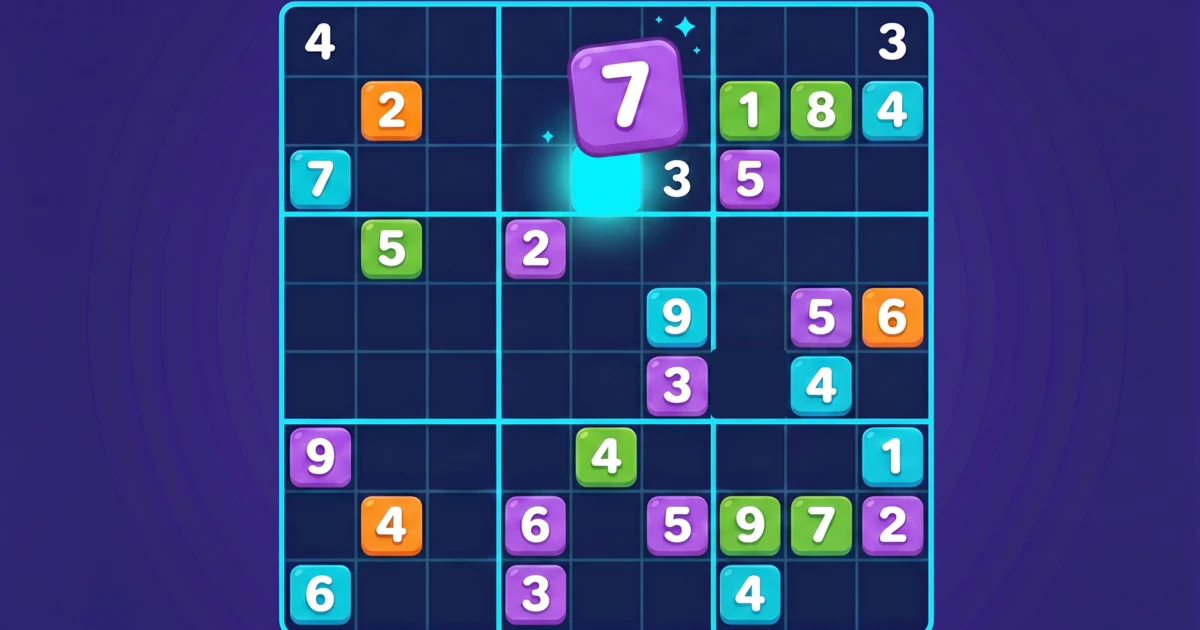
Killer Sudoku

Killer Sudoku

Dagelijkse puzzel

Killer Sudoku - Cage Sums Instead of Starting Numbers, Solo or With Friends

Varianten:Sudoku OnlineSudoku Online

3.0

Beoordeling

0

0

Killer Sudoku - Cage Sums Instead of Starting Numbers, Solo or With Friends

export function MiniCell({value, sum, sumTone}) { // Mirrors how the real board draws a cell: an opaque white square with a dark digit, and the // cage total tucked into the top-left corner just inside the dashed cage outline, in the same // three colors the board uses (see client/src/games/sudoku/SudokuGrid.tsx). const toneClass = sumTone === 'correct' ? 'text-green-600' : sumTone === 'over' ? 'text-red-600' : 'text-gray-500'; return (

{sum === undefined ? null : ( <span className={'absolute left-1 top-0.5 text-[11px] font-bold leading-none ' + toneClass}>{sum} )} {value ?? ''}
); }

export function combinationsOf(size, total) { // Every set of size different digits from 1-9 that adds up to total. const results = []; const walk = (start, left, remaining, picked) => { if (left === 0) { if (remaining === 0) { results.push(picked); } return; } for (let digit = start; digit <= 9; digit++) { walk(digit + 1, left - 1, remaining - digit, [...picked, digit]); } }; walk(1, size, total, []); return results; }

export function CageDemo() { const TARGETS = [ {total: 7, blurb: 'A low total leaves you almost no choice, so a cage like this is where you start solving.'}, {total: 15, blurb: 'The most flexible total there is. On its own it tells you almost nothing, so you need the row, column, and box to narrow it down.'}, {total: 24, blurb: 'Only one set again, at the top end. High and low totals are always the easiest cages to crack.'}, ]; const [target, setTarget] = useState(7); const [cells, setCells] = useState([null, null, null]); const filled = cells.filter(cell => cell !== null); const total = filled.reduce((sum, cell) => sum + cell, 0); const isFull = filled.length === 3; const tone = total > target || (isFull && total !== target) ? 'over' : isFull ? 'correct' : undefined; const combos = combinationsOf(3, target);

const place = digit => { if (cells.includes(digit)) { setCells(cells.map(cell => (cell === digit ? null : cell))); return; } const next = cells.indexOf(null); if (next >= 0) { setCells(cells.map((cell, i) => (i === next ? digit : cell))); } };

const pickTarget = nextTarget => { setTarget(nextTarget); setCells([null, null, null]); };

return (

Fill a Cage

This is one cage of three cells. Tap digits to drop them in, and tap a digit again to take it back out. The number in the corner is the total the three cells have to reach, and it turns green when you get there.

{TARGETS.map(option => ( <button key={option.total} type="button" onClick={() => pickTarget(option.total)} className={ 'rounded-lg px-3 py-1 text-sm font-bold text-white transition-none ' + (target === option.total ? 'bg-purple-500' : 'bg-white/10 hover:bg-white/20') } > Total {option.total} ))}
{cells.map((cell, i) => ( ))}
{[1, 2, 3, 4, 5, 6, 7, 8, 9].map(digit => ( <button key={digit} type="button" onClick={() => place(digit)} className={ 'h-9 w-9 rounded-lg text-lg font-bold active:scale-95 ' + (cells.includes(digit) ? 'bg-purple-500 text-white' : 'bg-white/10 text-white/80 hover:bg-white/20') } > {digit} ))}

{isFull && total === target ? 'That works. Every digit is different and they add up to the total.' : total > target ? 'Too high. Take a digit back out and try a smaller one.' : TARGETS.find(option => option.total === target).blurb}

{combos.length === 1 ? 'Only one set of three digits works: ' : ${combos.length} sets of three digits work: } {combos.map(combo => combo.join('+')).join(', ')}

); }

export function FortyFiveDemo() { // A single 3x3 box. Three cages sit entirely inside it and the ninth cell belongs to a cage // that carries on into the next box, which is the shape you look for when you use the 45 rule. const CELLS = [ {value: 1, cage: 'a', sum: 3}, {value: 2, cage: 'a'}, {value: 3, cage: 'b', sum: 14}, {value: 4, cage: 'c', sum: 19}, {value: 5, cage: 'b'}, {value: 6, cage: 'b'}, {value: 7, cage: 'c'}, {value: 8, cage: 'c'}, {value: 9, cage: 'outside'}, ]; const [isRevealed, setIsRevealed] = useState(false); const TONES = {a: 'bg-amber-400', b: 'bg-blue-400', c: 'bg-emerald-400', outside: 'bg-white/40'}; return (

{CELLS.map((cell, i) => (
<span className={'absolute bottom-1 left-1/2 h-1.5 w-7 -translate-x-1/2 rounded-full ' + TONES[cell.cage]} />
))}

The 45 rule

Three cages sit entirely inside this box, totalling 3, 14, and 19. That accounts for eight of the nine cells. The ninth belongs to a cage that carries on into the next box, so its total is no help here. The box has to hold 1 to 9 once each, so it adds up to 45, and the missing cell is whatever is left.

45 - 3 - 14 - 19 = {isRevealed ? '9' : '?'}

<button type="button" onClick={() => setIsRevealed(!isRevealed)} className="w-max rounded-lg bg-white/10 px-3 py-1 text-sm font-bold text-white hover:bg-white/20 active:scale-95" > {isRevealed ? 'Hide the answer' : 'Show the answer'}
); }

Killer Sudoku

Killer sudoku is a free online sudoku variant where the grid gives you sums instead of starting numbers. The board is carved into cages, small groups of neighbouring cells drawn with a dotted outline, and each cage prints the total its digits must reach. No digit repeats inside a cage, and the rest is normal sudoku: every row, every column, and every 3x3 box holds 1 to 9 once each. You can play it on this page right now in your browser, alone or with friends on a shared board, at four difficulty levels, with no download and no signup.

Because the cages carry the information, killer grids start almost bare. An Easy puzzle here opens with four given digits and Expert usually opens with none at all, so your first move comes from arithmetic rather than from scanning for a number that is already on the board.

Killer Sudoku Rules

There are two rules on top of ordinary sudoku, and they are both about cages. A cage's digits have to add up to the small number in its top-left corner, and a digit can only appear once inside a cage. The second rule matters more than it looks, because it is what makes a total useful. A three-cell cage adding to 7 could be 1+2+4 or 1+3+3 if repeats were allowed, but they are not, so 1+2+4 is the only option and all three cells are settled before you have placed anything else.

Extreme totals are the way in. Low totals have to use the small digits and high totals have to use the large ones, so a two-cell cage adding to 3 is 1 and 2, a two-cell cage adding to 17 is 8 and 9, and a three-cell cage adding to 24 is 7, 8, and 9. Middling totals like 15 are the vaguest and are usually the last cages you fill.

The other technique worth learning early is the 45 rule. Every row, column, and 3x3 box contains each digit once, so each one adds up to 45. Find a row, column, or box where every cage sits fully inside it except for a cell or two, add up the cage totals, and the difference from 45 is what is left over.

One last detail: a cage can be a single cell. When it is, its total is simply the digit that goes there, which is the same thing as a given number in classic sudoku. Easy puzzles here include eight of those and Expert includes three, and that gap is a large part of why the difficulties feel so different.

Play Killer Sudoku Online Free

The board at the top of this page is already set to killer, so pressing play is the fastest way in. From anywhere else on Foony, open Sudoku, choose Create Room, and pick the Killer Sudoku card from the presets, or flip the Variant setting from Classic to Killer on any room you are setting up.

Four difficulty levels change both the cage shapes and how much of the grid you get for free:

Easy and Medium

Cages hold up to four cells, and plenty of them hold just one. Easy starts with four given digits and Medium with one, on top of the single-cell cages.

Hard and Expert

Cages stretch to five cells and single-cell cages get rare. Both normally open with no given digits at all, so the sums are all you have.

Every puzzle has exactly one solution, and it is checked before you ever see it. The generator builds cages from a finished grid and then solves the result under killer rules to confirm the answer is forced, so you never have to guess.

The rest of the room settings work the same as classic sudoku. Mistake tolerance is Casual (unlimited), Normal (three mistakes), or Perfectionist (one mistake and the puzzle ends). The host can put a clock on it, anywhere from 5 to 60 minutes, or leave it off. Killer solves are given more time for the same reward than classic ones, because they take longer, and they are scored on their own scale so a long solve is not penalised.

While you play, the board does the arithmetic with you. Each cage total sits in the corner of its first cell, turns green once the cage is full and correct, and turns red the moment your digits pass the total, so a slip shows up on the spot instead of forty cells later. Selecting a cell tints the rest of its cage, which is the fastest way to see the shape of a cage that wraps around a corner. Pencil marks work exactly as they do in classic sudoku.

Multiplayer Killer Sudoku

Killer is the sudoku variant that benefits most from a second pair of eyes, and every Foony room supports one. Turn Co-op on when you create the room and everyone joins a single team sharing one grid, with live cursors, so you can split the board by region, have someone work the cage arithmetic while another person scans rows, or just talk through a corner that will not open. It is also the easiest way to teach the variant to someone, since they can watch a cage get cracked instead of reading about it.

Leave Co-op off and everyone gets the same puzzle on their own grid, with first to finish legally taking the win. That covers a 1v1 race, a friends-only match, and a tournament room, which holds up to 1,000 players on one seed. Share the room link and people join from any modern browser on desktop, tablet, or phone. No account is needed to play, only to keep levels, ranks, and unlocks across devices.

Killer Sudoku Tips and Cage Combinations

Sweep for extreme cages first. Before you place anything, look for two-cell cages totalling 3, 4, 16, or 17, and three-cell cages totalling 6, 7, 23, or 24. Each of those has exactly one possible set of digits, and one settled cage usually gives you a second through the ordinary row and column rules.

Use the 45 rule on the edges of the grid, where boxes are most likely to have a single cell poking out of a cage. It also works across several rows or columns at once. Two full rows add up to 90, three add up to 135, so a cage that spills a single cell out of a three-row band gives that cell away.

Watch for cages inside one row, column, or box. Their digits cannot repeat anywhere in that unit either, so a two-cell cage totalling 16 inside a single box removes 7 and 9 from every other cell in that box, which is often more useful than knowing where they go.

Play Hard and Expert in Casual mode until the arithmetic is second nature. A wrong digit in killer usually comes from a miscount rather than a broken deduction, and there is little to learn from a puzzle that ends on one. Switch to Perfectionist once you stop miscounting, and chase Flawless Victory then.

Sudoku Leaderboards, Achievements, and Boards

Killer solves count towards everything classic solves do. Wins feed the sudoku leaderboards, which filter by day, week, month, year, or all-time.

There are eight sudoku achievements and killer is a fair route to most of them. Flawless Victory asks for zero mistakes on any puzzle, Zen Master for a solve with no hints, and Hard as Nails and Puzzle Master for Hard and Expert solves with three mistakes or fewer, all of which count on a killer board. Quick Solve is the one to leave for classic, since it wants an Easy puzzle finished inside five minutes.

Playing also drops sudoku boards and number styles. There are 12 boards, including Wooden, Zen Garden, Blueprint, and Neon, and 12 number styles such as Ink Brush, Fountain Pen, and Gilded, with the Calligraphy style handed out at level 50. They change how the grid looks and nothing else. The dotted cage outlines and their totals draw over whichever board you have equipped.

Classic Sudoku and Other Puzzles

If the cage arithmetic is new to you, the sudoku page covers the base rules the variant is built on, along with the same co-op rooms, races, and difficulty levels. Working through a Hard classic puzzle first makes killer much easier to pick up, because once the cages have given you a dozen digits the rest of the solve is ordinary sudoku.

Sudoku Online: Veelgestelde Vragen

Kan ik co-op sudoku op hetzelfde bord spelen met een vriend?
Ja. Schakel Co-op (of "coop", hetzelfde) in wanneer je de kamer aanmaakt op Foony Sudoku, en iedereen in de lobby sluit zich aan bij één team dat één 9x9-bord deelt met live cursors in realtime. Je kunt secties verdelen onder teamgenoten, elkaars plaatsingen dubbelchecken voordat ze definitief worden, of gewoon overleggen via de chat bij de lastigere deducties op Moeilijke en Expert puzzels. Het is de makkelijkste manier om een beginner les te geven zonder over hun schouder mee te kijken.
Welke sudoku-moeilijkheidsgraden biedt Foony?
Foony Sudoku heeft vier moeilijkheidsniveaus, die per kamer één keer worden gekozen. Makkelijk vereist alleen de twee zetten waarmee iedereen begint: het enige cijfer dat nog in een vakje past, en het enige vakje waarin een cijfer nog past. Gemiddeld voegt paren toe, waarbij twee vakjes dezelfde twee cijfers delen en alle andere cijfers uit beide vakjes weren, plus de X-wing, waarbij een cijfer in twee rijen vastzit aan dezelfde twee kolommen. Moeilijk voegt drietallen en grotere versies van dat patroon toe, en hier beginnen potloodnotities echt hun vruchten af te werpen. Expert voegt ketens toe, waarbij je één cijfer door meerdere vakjes volgt om het ergens verderop uit te sluiten. Op hogere moeilijkheidsniveaus begin je met minder cijfers en krijg je na voltooiing meer XP en itemdrops.
Is Foony Sudoku gratis te spelen?
Ja. Foony Sudoku is volledig gratis in de browser. Er is geen betaalmuur op de puzzels, de multiplayer-kamers, de toernooien of de prestaties. De shop verkoopt optionele cosmetische borden en cijferstijlen; niets daarvan verandert de puzzelgenerator of de regels.
Wat is het verschil tussen Casual-, Normaal- en Perfectionist-modus?
De drie modi op Foony Sudoku veranderen hoe streng de fouttolerantie is. Casual staat onbeperkt fouten toe; de puzzel eindigt nooit in mislukking, wat ideaal is om te leren. Normaal staat maximaal drie fouten toe voordat het spel eindigt. Perfectionist beëindigt het spel bij één enkele foute plaatsing, wat de juiste instelling is als je jaagt op de Flawless Victory-prestatie of je vaardigheidsplafond opzoekt. Modi met hogere inzet leveren meer XP en meer item-drops op.
Hoe speel je sudoku?
Sudoku is een logische puzzel op een 9x9-raster verdeeld in negen 3x3-vakken. Het raster begint deels gevuld met cijfers van 1 tot 9. Je doel is om elke lege cel zo in te vullen dat elke rij, elke kolom en elk 3x3-vak elk cijfer 1 tot en met 9 precies één keer bevat. Er komt geen rekenwerk aan te pas, alleen logische deductie. Foony Sudoku markeert legale plaatsingen, toont conflicten in het rood en biedt potloodaantekeningen om kandidaatcijfers bij te houden in cellen waar je nog niet definitief voor hebt gekozen.
Kan ik sudoku spelen zonder me aan te melden?
Ja. Open Foony Sudoku en je staat aan het bord, geen account vereist. Meld je alleen aan als je level-synchronisatie tussen apparaten, blijvende ranglijstposities en shop-unlocks wilt. De volledige spelregels, alle vier de moeilijkheidsgraden, alle drie de spelmodi en de multiplayer-kamers zijn beschikbaar zonder account.
Hoe speel ik sudoku online met vrienden?
Open Foony Sudoku, klik op "Speel met Vrienden" om een privékamer aan te maken en deel vervolgens de uitnodigingslink. Vrienden doen mee vanuit elke moderne browser op desktop, tablet of telefoon, zonder accounts aan te maken en zonder iets te installeren. Kies de moeilijkheidsgraad, kies de modus (Casual / Normaal / Perfectionist), kies of de kamer co-op of race is, en je staat aan het bord.
Heeft Foony Sudoku ranglijsten, prestaties en cosmetische items?
Ja, alle drie. Overwinningen op Foony Sudoku tellen mee voor de openbare ranglijsten, die je kunt filteren op dag, week, maand, jaar of aller tijden. Er zijn 12 Prestaties in het spel, waaronder Foutloze Overwinning (geen fouten in welke puzzel dan ook), Snel Opgelost (een Makkelijke puzzel in minder dan 5 minuten), Spijkerhard en Puzzelmeester (Moeilijk / Expert met drie of minder fouten), Zenmeester (een puzzel opgelost zonder hints), en vier voor de dagelijkse puzzels, tot en met Moeilijkste van de Dag voor 100 dagelijkse Expert-puzzels. Er zijn 13 cosmetische borden (Hout, Zentuin, Blauwdruk, Glas-in-lood, Koivijver, Oude Boekrol en meer) en 13 cijferstijlen (Inktpen, Vulpen, Inktpenseel, Verguld, Kalligrafie, Edelsteen en meer), te verdienen in de Winkel, via drops of via de dagelijkse puzzels. Skins zijn puur visueel en hebben nooit invloed op de puzzelgenerator.
Kan ik tegen vrienden racen, 2 spelers sudoku spelen of een sudokutoernooi organiseren?
Ja, alle drie in één modus. Laat Co-op uitgeschakeld wanneer je de kamer aanmaakt op Foony Sudoku en elke speler in de lobby krijgt dezelfde startpuzzel op een eigen raster; de eerste die het bord legaal invult, wint. Dat dekt 1v1 / 2 spelers sudoku, een race onder vrienden en een competitief sudokutoernooi met maximaal 1.000 deelnemers op één seed. Combineer het met Perfectionist-fouttolerantie voor een meedogenloze sprint waarbij één foute plaatsing je elimineert, of Casual voor een ontspannen "wie is het eerst klaar"-ronde.
Kan ik een tijdslimiet instellen op een sudokupuzzel?
Ja. De host op Foony Sudoku kan een tijdslimiet instellen van een strakke 5 minuten tot 60 minuten per puzzel, of de klok volledig uitschakelen voor een ontspannen sessie zonder tijdsdruk. Tijdslimieten staan los van de moeilijkheidsgraad en de fouttolerantie-instellingen, dus je kunt een Expert-puzzel draaien met Casual-fouttolerantie en een klok van 60 minuten, of een Makkelijke puzzel in Perfectionist-modus met een sprint van 10 minuten.
Kan ik Foony Sudoku unblocked spelen op school of op het werk?
Foony Sudoku draait volledig in de browser, dus het werkt op de meeste school- en kantoornetwerken die op zichzelf staande game-installaties blokkeren. Er is geen uitvoerbaar bestand en geen app store-account nodig, en de pagina zelf wordt geladen vanaf foony.com via HTTPS. Als jouw netwerk foony.com rechtstreeks blokkeert, vraag dan aan de IT-beheerder om het toe te staan; we staan niet op de standaard "geblokkeerde games"-lijsten.
Hebben Foony-sudokupuzzels gegarandeerd één unieke oplossing?
Ja. Elke puzzel die op Foony Sudoku wordt gegenereerd, heeft precies één oplossing die je met pure logica kunt bereiken, zonder te gokken. Als je merkt dat je gokt, heb je ergens een beperking gemist of heb je een geavanceerdere techniek nodig (Moeilijk steunt op patronen die zich tegelijk over twee of drie rijen uitstrekken, en Expert op ketens die je van vakje naar vakje volgt). Een puzzel met meerdere oplossingen is per definitie een ongeldige Sudoku, en onze generator maakt er nooit zo een. Elke uitgebrachte puzzel wordt opnieuw gecontroleerd door Sudoku Explainer, de referentiebeoordelaar, en weggegooid als die het niet eens is met de moeilijkheidsgraad die wij eraan hebben gegeven.
8 Ball Pool online multiplayer billiards icon