


 Supporter Tidlig adgang

Mancala - The Classic Stone Board Game for 2 Players, Online with Friends or Bots
 Mancala Avalanche
 Sungka
 Mangala
5.0
Bedømmelse
4
0
Play Mancala Online with Friends
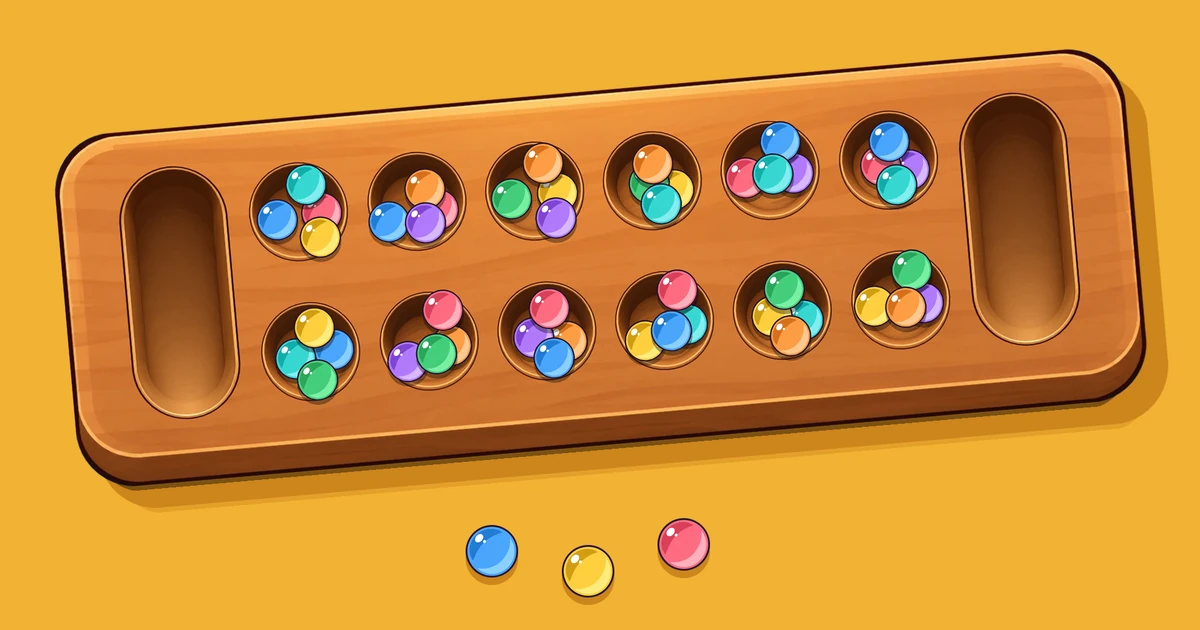
Foony Mancala is a free online mancala game with five rule sets, invite links for playing a friend, and five computer levels from Beginner to Expert. On your turn you pick up every stone in one of your pits and drop them one at a time around the board. The player with the most stones in their store at the end wins.
Every pit shows how many stones it holds, and the number changes as each stone lands, so you never have to count by hand. On a computer, when you hover over a pit, the pit where your last stone will land gets a white ring. Extra turns and captures show on the board as they happen, and captured pits flash red, so you can always see why the stones moved. On a phone held upright, the board stands on its end so the pits stay big enough to tap.
Two Player Mancala with Friends or the Computer
Create a room and send its link to a friend. Guests can join unless the host turns on Block Guests. You sit on opposite sides of the board, and your side is always drawn at the bottom of your own screen. If more people join, they're added to one of the two sides and take turns moving for it. Anyone else in the room can watch.
To practice alone, press Play Bots and pick Beginner, Easy, Normal, Hard, or Expert. You can also choose to go first, go second, or let the game pick. Beginner plays random pits. Each level above it looks further ahead more often, and Expert looks ten moves ahead in Classic, Oware and Mangala. In Avalanche and Sungka a single turn can chain on for dozens of stones, so the bots there look at most two moves ahead, and a bot that moves first can't win the game before you play. Expert also picks at random between equally good moves, so it doesn't play the same game every time.
Two people can share one screen with Play in Person. In a game against a friend you can ask to take a move back, and against a bot the Undo button takes back your move and its reply.
Mancala Rules and Settings
The host picks the rules before the game starts. Classic is the Kalah game most people mean by mancala. Avalanche, Oware, Sungka and Mangala are explained further down. The host can also change:
- Pits per Side, from 3 to 9. Sungka uses 7 and the other rule sets use 6.
- Stones per Pit, from 1 to 9. Fewer stones make a quicker game.
- Empty Capture, for Classic, Sungka and Mangala. When it's on, a last stone that lands in an empty pit on your side is captured even if the pit across from it is empty.
- Leftover Stones. When one side runs out, the game ends. Each side can keep the stones still on it (the usual rule), or every stone left can go to the player who ran out, as in Mangala.
- Random Start, which spreads the stones at random before each game. Both sides get the same layout, so it stays fair, and an opening you memorized won't work.
- Seconds per Turn, from 3 to 120, or No Timer. The clock waits while stones are still moving, so a long chain doesn't use up your time.
There's also a button beside your seat that makes the stones move twice as fast on your screen. It only changes your own view.
How to Play Mancala
The board has two rows of pits. The row nearest you is yours, and so is the long pit at your right, called your store. Stones travel counterclockwise: along your row to your store, then back along your opponent's row. You drop stones into your own store as you pass it, but never into your opponent's.
To move, pick one of your pits that has stones. All of its stones are lifted and sown, one into each pit after it. If your last stone lands in your own store, you take another turn right away. A careful player can chain several of these in a row.
How to Capture in Mancala
If your last stone lands in an empty pit on your side, and the pit straight across holds stones, you capture. Your stone and every stone across from it go into your store, and your turn ends. If the pit across is empty, nothing happens unless the host turned on Empty Capture.
How a Game of Mancala Ends
The game ends as soon as all six pits on one side are empty. With the usual rule, each player then moves the stones left on their own side into their store. Count the stores, and the bigger one wins. With 48 stones in a Classic game, 25 is enough to be sure of the win.
Mancala Strategy and How to Win
- Count before you move. A pit that's a certain number of steps from your store, holding exactly that many stones, ends in your store for a free turn. The pit right next to your store always does with one stone.
- Take the free turn nearest your store first. Playing a farther pit first drops a stone into the nearer ones and spoils their exact count.
- Learn the classic opening. If you move first, play your third pit, which ends in your store, then your sixth. With perfect play the first player can always win a Classic game by 8 stones, but people rarely play perfectly.
- Guard the pits across from empty ones. Before every move, look for an empty pit on your opponent's side that one of their pits can reach. A big pile across from it is a capture waiting to happen.
- Keep stones home near the end. With the usual rule, stones left on your side are yours. When you're ahead, make small moves and let your opponent run out first.
Mancala Leaderboards and Achievements
Compare your results on the Mancala leaderboards. There are seven Mancala achievements. First Harvest is for finishing a game. On a Roll is for taking 10 extra turns in a row on the usual board of any rule set but Oware, which has no extra turns. The other five each belong to one rule set on its usual board: Landslide for a Classic win with at least 36 of the 48 stones, Rockslide for an Avalanche win that includes a move picking stones up 18 or more times, Big Harvest for an Oware win with at least 30 stones, Full House for a Sungka win with at least 72 of the 98 stones, and Treasure Trove for a Mangala win with at least 36 stones. A win because the other player left doesn't count toward these five.
Mancala, Kalah, Oware, Sungka and Mangala
Mancala isn't one game but a whole family of games where stones or seeds are sown around rows of pits, played across Africa, the Middle East, South and Southeast Asia, and beyond. The mancala family includes hundreds of rule sets. Foony has five of the best known:
- Classic (Kalah) is the two-row game with stores that most American players grew up with.
- Avalanche keeps sowing: when your last stone lands in a pit that already has stones, you pick them all up and carry on. There are no captures.
- Oware, also called Awale or Ayo, is played across West Africa. Stores aren't part of the sowing, and you capture pits on the other side that end with 2 or 3 stones. If your opponent has no stones, you must give them some if you can. More than half the stones wins.
- Sungka, played in the Philippines and known as congkak in Malaysia and congklak in Indonesia, uses 7 pits of 7 stones with chain sowing and captures.
- Mangala, from Turkey, drops a move's first stone back into the pit it came from and captures any pile you make even on the other side.
If you like games where every move is in the open and planning ahead wins, try online checkers or Four in a Row next.