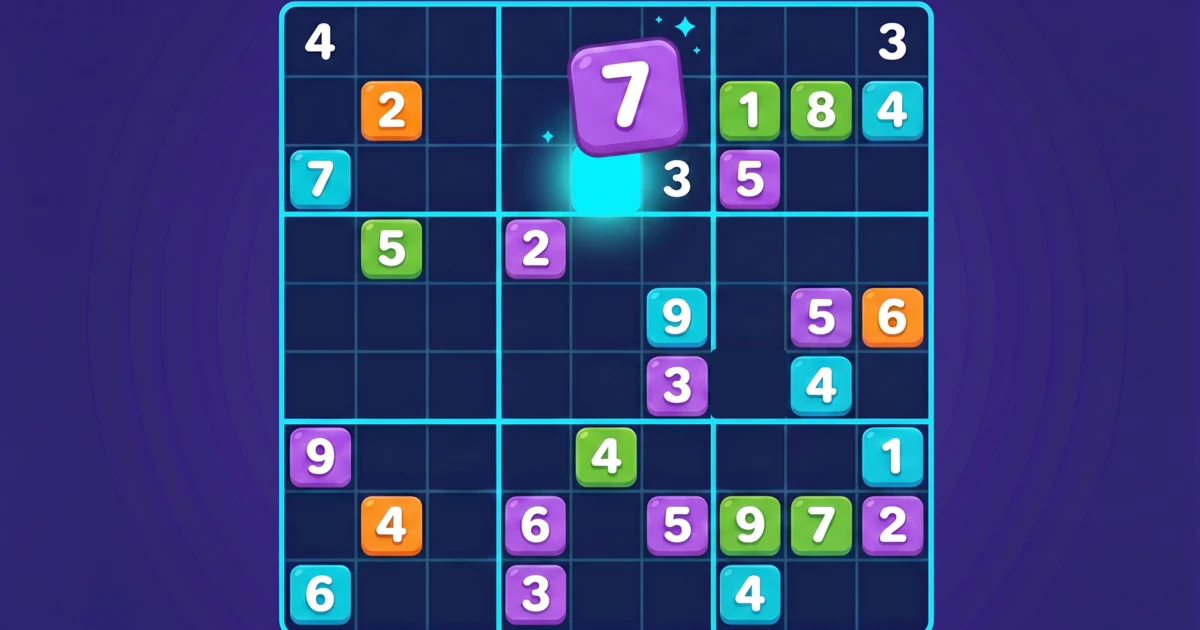
Killer Sudoku

Killer Sudoku

Dagens pussel

Killer Sudoku - Cage Sums Instead of Starting Numbers, Solo or With Friends

Varianter:Sudoku OnlineSudoku Online

3.0

Betyg

0

0

Killer Sudoku - Cage Sums Instead of Starting Numbers, Solo or With Friends

export function MiniCell({value, sum, sumTone}) { // Mirrors how the real board draws a cell: an opaque white square with a dark digit, and the // cage total tucked into the top-left corner just inside the dashed cage outline, in the same // three colors the board uses (see client/src/games/sudoku/SudokuGrid.tsx). const toneClass = sumTone === 'correct' ? 'text-green-600' : sumTone === 'over' ? 'text-red-600' : 'text-gray-500'; return (

{sum === undefined ? null : ( <span className={'absolute left-1 top-0.5 text-[11px] font-bold leading-none ' + toneClass}>{sum} )} {value ?? ''}
); }

export function combinationsOf(size, total) { // Every set of size different digits from 1-9 that adds up to total. const results = []; const walk = (start, left, remaining, picked) => { if (left === 0) { if (remaining === 0) { results.push(picked); } return; } for (let digit = start; digit <= 9; digit++) { walk(digit + 1, left - 1, remaining - digit, [...picked, digit]); } }; walk(1, size, total, []); return results; }

export function CageDemo() { const TARGETS = [ {total: 7, blurb: 'A low total leaves you almost no choice, so a cage like this is where you start solving.'}, {total: 15, blurb: 'The most flexible total there is. On its own it tells you almost nothing, so you need the row, column, and box to narrow it down.'}, {total: 24, blurb: 'Only one set again, at the top end. High and low totals are always the easiest cages to crack.'}, ]; const [target, setTarget] = useState(7); const [cells, setCells] = useState([null, null, null]); const filled = cells.filter(cell => cell !== null); const total = filled.reduce((sum, cell) => sum + cell, 0); const isFull = filled.length === 3; const tone = total > target || (isFull && total !== target) ? 'over' : isFull ? 'correct' : undefined; const combos = combinationsOf(3, target);

const place = digit => { if (cells.includes(digit)) { setCells(cells.map(cell => (cell === digit ? null : cell))); return; } const next = cells.indexOf(null); if (next >= 0) { setCells(cells.map((cell, i) => (i === next ? digit : cell))); } };

const pickTarget = nextTarget => { setTarget(nextTarget); setCells([null, null, null]); };

return (

Fill a Cage

This is one cage of three cells. Tap digits to drop them in, and tap a digit again to take it back out. The number in the corner is the total the three cells have to reach, and it turns green when you get there.

{TARGETS.map(option => ( <button key={option.total} type="button" onClick={() => pickTarget(option.total)} className={ 'rounded-lg px-3 py-1 text-sm font-bold text-white transition-none ' + (target === option.total ? 'bg-purple-500' : 'bg-white/10 hover:bg-white/20') } > Total {option.total} ))}
{cells.map((cell, i) => ( ))}
{[1, 2, 3, 4, 5, 6, 7, 8, 9].map(digit => ( <button key={digit} type="button" onClick={() => place(digit)} className={ 'h-9 w-9 rounded-lg text-lg font-bold active:scale-95 ' + (cells.includes(digit) ? 'bg-purple-500 text-white' : 'bg-white/10 text-white/80 hover:bg-white/20') } > {digit} ))}

{isFull && total === target ? 'That works. Every digit is different and they add up to the total.' : total > target ? 'Too high. Take a digit back out and try a smaller one.' : TARGETS.find(option => option.total === target).blurb}

{combos.length === 1 ? 'Only one set of three digits works: ' : ${combos.length} sets of three digits work: } {combos.map(combo => combo.join('+')).join(', ')}

); }

export function FortyFiveDemo() { // A single 3x3 box. Three cages sit entirely inside it and the ninth cell belongs to a cage // that carries on into the next box, which is the shape you look for when you use the 45 rule. const CELLS = [ {value: 1, cage: 'a', sum: 3}, {value: 2, cage: 'a'}, {value: 3, cage: 'b', sum: 14}, {value: 4, cage: 'c', sum: 19}, {value: 5, cage: 'b'}, {value: 6, cage: 'b'}, {value: 7, cage: 'c'}, {value: 8, cage: 'c'}, {value: 9, cage: 'outside'}, ]; const [isRevealed, setIsRevealed] = useState(false); const TONES = {a: 'bg-amber-400', b: 'bg-blue-400', c: 'bg-emerald-400', outside: 'bg-white/40'}; return (

{CELLS.map((cell, i) => (
<span className={'absolute bottom-1 left-1/2 h-1.5 w-7 -translate-x-1/2 rounded-full ' + TONES[cell.cage]} />
))}

The 45 rule

Three cages sit entirely inside this box, totalling 3, 14, and 19. That accounts for eight of the nine cells. The ninth belongs to a cage that carries on into the next box, so its total is no help here. The box has to hold 1 to 9 once each, so it adds up to 45, and the missing cell is whatever is left.

45 - 3 - 14 - 19 = {isRevealed ? '9' : '?'}

<button type="button" onClick={() => setIsRevealed(!isRevealed)} className="w-max rounded-lg bg-white/10 px-3 py-1 text-sm font-bold text-white hover:bg-white/20 active:scale-95" > {isRevealed ? 'Hide the answer' : 'Show the answer'}
); }

Killer Sudoku

Killer sudoku is a free online sudoku variant where the grid gives you sums instead of starting numbers. The board is carved into cages, small groups of neighbouring cells drawn with a dotted outline, and each cage prints the total its digits must reach. No digit repeats inside a cage, and the rest is normal sudoku: every row, every column, and every 3x3 box holds 1 to 9 once each. You can play it on this page right now in your browser, alone or with friends on a shared board, at four difficulty levels, with no download and no signup.

Because the cages carry the information, killer grids start almost bare. An Easy puzzle here opens with four given digits and Expert usually opens with none at all, so your first move comes from arithmetic rather than from scanning for a number that is already on the board.

Killer Sudoku Rules

There are two rules on top of ordinary sudoku, and they are both about cages. A cage's digits have to add up to the small number in its top-left corner, and a digit can only appear once inside a cage. The second rule matters more than it looks, because it is what makes a total useful. A three-cell cage adding to 7 could be 1+2+4 or 1+3+3 if repeats were allowed, but they are not, so 1+2+4 is the only option and all three cells are settled before you have placed anything else.

Extreme totals are the way in. Low totals have to use the small digits and high totals have to use the large ones, so a two-cell cage adding to 3 is 1 and 2, a two-cell cage adding to 17 is 8 and 9, and a three-cell cage adding to 24 is 7, 8, and 9. Middling totals like 15 are the vaguest and are usually the last cages you fill.

The other technique worth learning early is the 45 rule. Every row, column, and 3x3 box contains each digit once, so each one adds up to 45. Find a row, column, or box where every cage sits fully inside it except for a cell or two, add up the cage totals, and the difference from 45 is what is left over.

One last detail: a cage can be a single cell. When it is, its total is simply the digit that goes there, which is the same thing as a given number in classic sudoku. Easy puzzles here include eight of those and Expert includes three, and that gap is a large part of why the difficulties feel so different.

Play Killer Sudoku Online Free

The board at the top of this page is already set to killer, so pressing play is the fastest way in. From anywhere else on Foony, open Sudoku, choose Create Room, and pick the Killer Sudoku card from the presets, or flip the Variant setting from Classic to Killer on any room you are setting up.

Four difficulty levels change both the cage shapes and how much of the grid you get for free:

Easy and Medium

Cages hold up to four cells, and plenty of them hold just one. Easy starts with four given digits and Medium with one, on top of the single-cell cages.

Hard and Expert

Cages stretch to five cells and single-cell cages get rare. Both normally open with no given digits at all, so the sums are all you have.

Every puzzle has exactly one solution, and it is checked before you ever see it. The generator builds cages from a finished grid and then solves the result under killer rules to confirm the answer is forced, so you never have to guess.

The rest of the room settings work the same as classic sudoku. Mistake tolerance is Casual (unlimited), Normal (three mistakes), or Perfectionist (one mistake and the puzzle ends). The host can put a clock on it, anywhere from 5 to 60 minutes, or leave it off. Killer solves are given more time for the same reward than classic ones, because they take longer, and they are scored on their own scale so a long solve is not penalised.

While you play, the board does the arithmetic with you. Each cage total sits in the corner of its first cell, turns green once the cage is full and correct, and turns red the moment your digits pass the total, so a slip shows up on the spot instead of forty cells later. Selecting a cell tints the rest of its cage, which is the fastest way to see the shape of a cage that wraps around a corner. Pencil marks work exactly as they do in classic sudoku.

Multiplayer Killer Sudoku

Killer is the sudoku variant that benefits most from a second pair of eyes, and every Foony room supports one. Turn Co-op on when you create the room and everyone joins a single team sharing one grid, with live cursors, so you can split the board by region, have someone work the cage arithmetic while another person scans rows, or just talk through a corner that will not open. It is also the easiest way to teach the variant to someone, since they can watch a cage get cracked instead of reading about it.

Leave Co-op off and everyone gets the same puzzle on their own grid, with first to finish legally taking the win. That covers a 1v1 race, a friends-only match, and a tournament room, which holds up to 1,000 players on one seed. Share the room link and people join from any modern browser on desktop, tablet, or phone. No account is needed to play, only to keep levels, ranks, and unlocks across devices.

Killer Sudoku Tips and Cage Combinations

Sweep for extreme cages first. Before you place anything, look for two-cell cages totalling 3, 4, 16, or 17, and three-cell cages totalling 6, 7, 23, or 24. Each of those has exactly one possible set of digits, and one settled cage usually gives you a second through the ordinary row and column rules.

Use the 45 rule on the edges of the grid, where boxes are most likely to have a single cell poking out of a cage. It also works across several rows or columns at once. Two full rows add up to 90, three add up to 135, so a cage that spills a single cell out of a three-row band gives that cell away.

Watch for cages inside one row, column, or box. Their digits cannot repeat anywhere in that unit either, so a two-cell cage totalling 16 inside a single box removes 7 and 9 from every other cell in that box, which is often more useful than knowing where they go.

Play Hard and Expert in Casual mode until the arithmetic is second nature. A wrong digit in killer usually comes from a miscount rather than a broken deduction, and there is little to learn from a puzzle that ends on one. Switch to Perfectionist once you stop miscounting, and chase Flawless Victory then.

Sudoku Leaderboards, Achievements, and Boards

Killer solves count towards everything classic solves do. Wins feed the sudoku leaderboards, which filter by day, week, month, year, or all-time.

There are eight sudoku achievements and killer is a fair route to most of them. Flawless Victory asks for zero mistakes on any puzzle, Zen Master for a solve with no hints, and Hard as Nails and Puzzle Master for Hard and Expert solves with three mistakes or fewer, all of which count on a killer board. Quick Solve is the one to leave for classic, since it wants an Easy puzzle finished inside five minutes.

Playing also drops sudoku boards and number styles. There are 12 boards, including Wooden, Zen Garden, Blueprint, and Neon, and 12 number styles such as Ink Brush, Fountain Pen, and Gilded, with the Calligraphy style handed out at level 50. They change how the grid looks and nothing else. The dotted cage outlines and their totals draw over whichever board you have equipped.

Classic Sudoku and Other Puzzles

If the cage arithmetic is new to you, the sudoku page covers the base rules the variant is built on, along with the same co-op rooms, races, and difficulty levels. Working through a Hard classic puzzle first makes killer much easier to pick up, because once the cages have given you a dozen digits the rest of the solve is ordinary sudoku.

Sudoku Online: Vanliga frågor

Kan jag spela co-op sudoku på samma bräda med en vän?
Ja. Aktivera Co-op (eller "coop", samma sak) när du skapar rummet på Foony Sudoku, så hamnar alla i lobbyn i ett lag som delar en enda 9x9-bräda med live-pekare i realtid. Ni kan dela upp sektioner mellan lagkamrater, dubbelkolla varandras placeringar innan de låses, eller bara chatta er igenom de knepigare deduktionerna i Svåra och Expert-pussel. Det är det enklaste sättet att lära en nybörjare utan att luta sig över axeln på dem.
Vilka sudoku-svårighetsnivåer erbjuder Foony?
Foony Sudoku har fyra svårighetsgrader som väljs en gång per rum. Lätt kräver bara de två tekniker som alla börjar med: den enda siffran som fortfarande passar i en ruta och den enda rutan där en siffra fortfarande kan placeras. Medel lägger till par, där två rutor delar samma två siffror och utesluter allt annat från båda, samt X-wing, där en siffra är låst till samma två kolumner på två rader. Svår lägger till tripplar och större versioner av det mönstret, och här börjar det verkligen löna sig att skriva anteckningar. Expert lägger till kedjor, där du följer en siffra genom flera rutor för att utesluta den någonstans långt borta. Högre svårighetsgrader börjar med färre siffror och ger mer XP och fler föremålsdropp när du klarar dem.
Är Foony Sudoku gratis att spela?
Ja. Foony Sudoku är helt gratis i webbläsaren. Det finns ingen betalvägg på pusslen, multiplayer-rummen, turneringarna eller prestationerna. Butiken säljer valfria kosmetiska brädor och sifferstilar; inget där ändrar pusselgeneratorn eller reglerna.
Vad är skillnaden mellan Avslappnad-, Normal- och Perfektionist-läget?
De tre lägena på Foony Sudoku ändrar hur strikt misstagstoleransen är. Avslappnad tillåter obegränsade misstag; pusslet slutar aldrig i misslyckande, vilket är idealiskt för att lära sig. Normal tillåter upp till tre misstag innan spelet tar slut. Perfektionist avslutar spelet vid en enda felplacering, vilket är rätt inställning om du jagar prestationen Flawless Victory eller pressar ditt skicklighetstak. Lägen med högre insatser ger mer XP och fler föremålsdrops.
Hur spelar man sudoku?
Sudoku är ett logikpussel på ett 9x9-rutnät indelat i nio 3x3-rutor. Rutnätet börjar delvis ifyllt med siffror från 1 till 9. Ditt mål är att fylla varje tom ruta så att varje rad, varje kolumn och varje 3x3-ruta innehåller varje siffra 1 till 9 exakt en gång. Ingen aritmetik är inblandad, bara logisk deduktion. Foony Sudoku markerar lagliga placeringar, visar konflikter i rött och har anteckningssiffror för att hålla reda på kandidatsiffror i rutor du ännu inte bestämt dig för.
Kan jag spela sudoku utan att registrera mig?
Ja. Öppna Foony Sudoku så är du vid brädet, inget konto krävs. Registrera dig bara om du vill ha nivåsynkning mellan enheter, beständiga topplisteplaceringar och butikslås. Hela regelverket, alla fyra svårighetsnivåer, alla tre spellägen och multiplayer-rummen är tillgängliga utan konto.
Hur spelar jag sudoku online med vänner?
Öppna Foony Sudoku, klicka på "Spela med vänner" för att skapa ett privat rum och dela sedan inbjudningslänken. Vännerna ansluter från valfri modern webbläsare på dator, surfplatta eller mobil – inga konton att skapa och inget att installera. Välj svårighetsgrad, välj läge (Avslappnad / Normal / Perfektionist), välj om rummet är co-op eller race, så är ni vid brädet.
Har Foony Sudoku topplistor, prestationer och kosmetiska föremål?
Ja, alla tre. Vinster på Foony Sudoku räknas på de offentliga topplistorna, som kan filtreras efter dag, vecka, månad, år eller genom tiderna. Det finns 12 prestationer i spelet, bland annat Felfri seger (noll misstag i valfritt pussel), Snabblöst (ett lätt pussel på under 5 minuter), Stenhård och Pusselmästare (Svår/Expert med högst tre misstag), Zenmästare (ett pussel löst utan ledtrådar) och fyra för de dagliga pusslen, ända upp till Dagens svåraste för 100 dagliga expertpussel. Det finns 13 dekorativa bräden (Trä, Zen-trädgård, Ritning, Glasmosaik, Koidamm, Uråldrig skriftrulle med flera) och 13 sifferstilar (Bläckpenna, Reservoarpenna, Tuschpensel, Förgylld, Kalligrafi, Ädelsten med flera), som du får från butiken, droppar eller de dagliga pusslen. Utseenden är enbart visuella och påverkar aldrig pusselgeneratorn.
Kan jag tävla mot vänner, spela 2-spelarsudoku eller köra en sudoku-turnering?
Ja, alla tre i samma läge. Lämna Co-op avstängt när du skapar rummet på Foony Sudoku och varje spelare i lobbyn får samma startpussel på sitt eget rutnät; först att lagligt fylla brädet vinner. Det täcker 1v1 / 2-spelarsudoku, ett race med bara vänner och en konkurrenskraftig sudoku-turnering med upp till 1 000 deltagare på samma seed. Kombinera det med Perfektionist-misstagstolerans för en brutal sprint där en felplacering eliminerar dig, eller Avslappnad för en lugn "vem blir klar först"-runda.
Kan jag sätta en tidsgräns på ett sudokupussel?
Ja. Värden på Foony Sudoku kan ställa in en tidsgräns från snäva 5 minuter upp till 60 minuter per pussel, eller stänga av klockan helt för en avslappnad otidtagen session. Tidsgränser är oberoende av svårighetsgraden och misstagstoleransinställningarna, så du kan köra ett Expert-pussel med Avslappnad misstagstolerans och 60 minuters klocka, eller ett Lätt pussel i Perfektionist-läge med en 10-minuters sprint.
Kan jag spela Foony Sudoku oblockerat i skolan eller på jobbet?
Foony Sudoku körs helt i webbläsaren, så det fungerar på de flesta skol- och kontorsnätverk som blockerar fristående spelinstallationer. Det finns ingen körbar fil att starta och inget app store-konto, och själva sidan laddas från foony.com över HTTPS. Om ditt nätverk blockerar foony.com direkt, be den som sköter IT att tillåta det; vi finns inte med på standardlistorna över "blockerade spel".
Garanterat att Foonys sudokupussel har en unik lösning?
Ja. Varje pussel som skapas på Foony Sudoku har exakt en lösning som går att nå med ren logik, utan att du behöver gissa. Om du märker att du gissar har du missat en begränsning någonstans eller behöver använda en mer avancerad teknik (Svår bygger på mönster som sträcker sig över två eller tre rader samtidigt, medan Expert bygger på kedjor som du följer från ruta till ruta). Ett pussel med flera lösningar är per definition en ogiltig Sudoku, och vår generator skapar aldrig sådana. Varje pussel som släpps dubbelkontrolleras av referensverktyget Sudoku Explainer och kastas bort om det inte håller med om svårighetsgraden vi har gett pusslet.
8 Ball Pool online multiplayer billiards icon